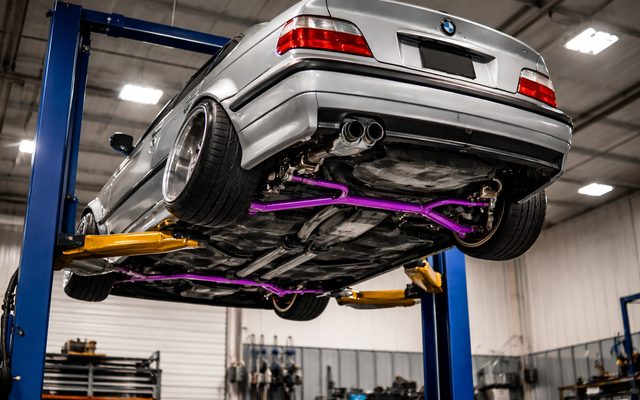
In the demanding world of today's professional oversteer competition, success is not merely purely a product of sheer horsepower or pilot aggression. Instead, it has evolved into a multifaceted science which necessitates a meticulous marriage of picking a proven vehicle platform, equipping it with the most precise competition components, and, most importantly, grasping its live behavior on the circuit through cutting-edge drift telemetry software. This comprehensive manual functions as your roadmap from the initial idea of a competition vehicle all the way to the final telemetry-optimized tweaks that turn a strong machine into a consistent podium finisher. We will examine in detail the precise engineering of chassis dynamics adjustment, illustrating how a advanced vehicle dynamics tool like GripDial eradicates approximation and provides unparalleled clarity into your chassis's actual behavior.
The bedrock of any great drift car is, undoubtedly, the platform itself. A select group of cars have earned iconic status within the global drifting scene due to their built-in handling characteristics, durable build quality, and the vast availability of performance support available. Picking the correct starting point is the initial and most crucial selection a enthusiast will make. For instance, the the E36 generation BMW is universally acknowledged as perhaps the the finest balanced cars for drifting of all time. Its excellent balanced front-to-rear weight, coupled with a RWD layout and extremely reliable inline-six engines, establishes a chassis that is simultaneously forgiving for novices and incredibly competitive in the possession of a professional competitor. The evolution of this concept, the BMW E46, improves on these qualities with a increasingly developed chassis, broader stance for enhanced confidence, and even a greater degree of turning capability straight from the manufacturer. Another dominant contender in the pro scene is the Chevrolet Corvette C6.
This V8-powered track weapon brings a distinctive combination of advantages to the sliding discipline, featuring a lightweight aluminium structure, a rear-mounted gearbox and differential unit that aids in an perfect weight distribution, and the tremendous low-end power of a powerful LS-series V8 engine. This combination renders it an complete force on track, able of initiating and holding long slides with relatively easy deployment of throttle. For drivers seeking outstanding performance per dollar, the 350Z model Nissan excels as a prime choice. It is delivered from the factory with a rigid platform, a competent OEM limited-slip differential, and the free-revving V6 engine that offers plenty of power and torque for practicing and advancing in the sport. Its follow-up, the 370Z model, brings additional refinements in body strength, steering geometry, and peak motor performance, solidifying its status as a popular pick among competitive pilots. Additional historic cars that warrant consideration are the lightweight unique Mazda FC RX-7, the ubiquitous S13 Silvia/240SX, the American SN95 generation Mustang, the electronic-equipped BMW E90, and the tiny yet unbelievably fun and instructive Mazda MX-5. Each of these cars gives a different array of attributes, challenges, and capabilities, but they all have in common the basic ingredients required to serve as a serious drift car.
However, choosing the right chassis is only the starting point. To access the true capability of every of these machines, major modifications to the steering system and damping and springing systems are utterly essential. This is where the domain of precision tuning parts enters vital importance. The most most transformative upgrade for a serious drift machine is the fitting of a high-performance angle modification kit. These sophisticated systems, like those developed by specialist companies like SLR, are engineered to significantly expand the car's available turning lock. A standard street car is severely limited in how far its front wheels can turn, a design compromise for on-road driving. In drifting, however, aggressive countersteering is continuously necessary to control and maintain a slide. An angle kit exchanges the factory uprights, linkages, and potentially suspension arms with parts that enable the wheels to attain angles in excess of 70 or even 80 degrees, as opposed to a normal stock angle of around 40 to 50 degrees.
This immensely expanded capability gives the pilot with significantly enhanced control during a angle, making it considerably more straightforward to start a drift, sustain it through a long corner, and change smoothly from one direction to the opposite. The contrast in handling is absolutely transformative. Combined with a appropriately specified steering kit is the every bit as essential modification to the car's spring and damper setup. Off-the-shelf or including premium sport adjustable suspension are generally not engineered for the specific and brutal requirements of sliding. A purpose-built pair of adjustable dampers is of utmost importance. These engineered coilovers incorporate specific damping rates and spring rates that are optimized for the rapid weight transfer that is typical of aggressive driving. When a driver initiates a angle, the chassis's inertia is shifted violently to the outside of the corner. Optimal drift-spec dampers control this transfer in a predictable manner, allowing the chassis to find its balance promptly and offering the operator accurate response through the controls and seat. They also allow for precise setting of stance, damping firmness, and weight balance, which are all integral parts of dialing in the chassis's dynamics to a specific track or piloting approach. As a system, a high-quality steering angle kit and a correctly chosen pair of drift-spec coilovers constitute the undeniable physical cornerstone upon which all subsequent tuning is constructed.
Once the essential hardware is in place, the next essential step in the build is the precise setting of the vehicle's suspension geometry. This is the world of vehicle alignment optimization, a methodology that can seem intimidating to the beginner but is, in reality, the secret to turning a collection of high-performance components into a harmonious and predictable vehicle. The most critical element of tuning for sliding is definitely camber angle. Camber is the tilt of the wheel in relation to the vertical line when viewed from the forward of the vehicle. If the top of the tire is tilted towards the car, this is called camber-in. In sliding, negative camber on the front axle wheels is generally employed and is seen as essential. The purpose is fundamentally tied to tire contact.
When a car is cornering at limit slip angles, the body tilts towards the outside of the bend. This chassis roll causes the outer steering tire to lose its best footprint with the tarmac. By applying an inward tilt, the wheel is pre-angled to compensate for this tilt. As the car tilts into the bend, the tire becomes more upright on the track, increasing its grip at the precise moment when it is needed most for directional command. Commonly, front axle angles for a serious drift car range from approximately -3 degrees to as high as -5 degrees or even beyond, based on the details of the chassis setup, compound selection, and pilot preference. The back tires also employ inward tilt, but the angles are typically less and more nuanced than the front axle. Excessive inward lean at the back can make the car excessively prone to oversteer and difficult to manage on acceleration application, as it diminishes the available grip area of the driving wheels during linear throttle application. Therefore, rear angles are commonly in the range of -1 degree to -3 degrees, finding a precise balance between providing sufficient cornering traction to help in entering and holding the angle while still keeping effective hook-up for power-down the bend. Camber is merely one element of the broader alignment equation, which furthermore encompasses toe setting, caster, and suspension-induced steering correction.
Toe angle describes the orientation of the wheels when viewed from a bird's-eye view. Inward toe means the front edges of the tires are nearer together than the rear edges, while toe-out means the converse. For sliding, a small amount of front axle toe out is often run to quicken the initial directional reaction, making the car feel more responsive and eager to begin a drift. Rear toe is generally set to zero or a incredibly small amount of positive toe to foster straight-line stability under throttle. self-centering is the longitudinal or aft angle of the kingpin axis when looked at from the side-on of the vehicle. Positive caster enhances self-centering and stability confidence, and it additionally increases negative camber effect during turning, which is very useful. Tuning these settings is a complex dance where a adjustment to a single value can and often will affect the others. The old-school approach for tuning a chassis's suspension geometry for competition has long been a tedious process of guesswork and adjustment. A pilot or engineering group would introduce a modification based on a hunch, run the car on track, depend on the driver's individual sensation and comments, and then make another change. This process would iterate time after time until the car felt "acceptable" or the available practice session was exhausted. This system is not just exceptionally wasteful in terms of man-hours and costs, but it is furthermore deeply flawed.
Pilot feel is a famously subjective metric, affected by numerous factors such as fatigue, varying track surfaces, temperature, and simply the mindset of the operator on that specific session. What feels "tail-happy" on one run might feel "pushing" on the next pass, resulting in contradictory data and ineffective changes. This long-standing challenge in chassis setup is specifically where state-of-the-art engineering tools has made its mark to revolutionize the process.
The rise and adoption of specialized suspension tuning applications has brought about a new age for building and perfecting competitive sliding vehicles. These platforms, exemplified by cutting-edge solutions like data acquisition tools, work by directly capturing the actual mechanical performance of the vehicle as it is operated on the circuit. Unlike using personal feedback, these systems gather objective information on key variables such as damper compression and extension, wheel speed, acceleration forces, wheel angle, and accelerator and brake pedal application. This collected telemetry is then interpreted by sophisticated applications drift telemetry software that can graph and interpret the data in a actionable way. For the first time ever, drivers and crews can observe precisely what the vehicle is exhibiting at any given moment of a slide. This ability changes the complete suspension tuning process. Consider the specific challenge of dialing in the front axle camber for a particular chassis. Instead of making a modification from -3 degrees to -3.5 degrees and then driving several runs to try and "sense" a difference, a telemetry system can give immediate and clear information. The application can indicate graphically how the tire's loading is performing during the key stages of a angle: initiation, sustain, and transition. It can demonstrate if the existing camber setting is enabling the steering tire to achieve optimal contact or if the tire is over-stressed on its outside edge.
The tool can subsequently suggest fact-based advice for change. Perhaps the telemetry shows that the outside front tire is even stressing its sidewall at -3.5 degrees of camber, indicating that a move towards negative camber, say -4 degrees, might be warranted. On the other hand, the data might show that the tire is failing to coming up to heat or that the inner edge is degrading too quickly, which could indicate that there is overly aggressive angle and a modest reduction back to -3.2 degrees would be better optimal. This level of granularity and useful analysis was literally impossible in the era of pure manual adjustment.
The effect of using a dedicated vehicle dynamics tool extends well beyond just dialing in camber angles. It functions as an invaluable suspension tuning guide that is tailored to your exact car. When fine-tuning the rebound and compression values on suspension engineering your suspension, instead of relying on vague advice or replicating another team's settings, you can use the data to analyze how the car is behaving in response to your changes. The software can graph the wheel movement path over a lap, vehicle dynamics tool showing if the dampers are managing the chassis motion properly or if they are causing the chassis to oscillate uncontrollably after a transition. It can assist in diagnosing problems like bottoming out or losing droop, permitting you to apply data-backed decisions to spring preload, damping settings, or ground clearance. This process applies similarly to the complex task of car alignment tuning. In addition to camber, the tool can give data into how modifications to toe and caster are influencing the vehicle's balance during specific maneuvers of a slide. For instance, it can assist you to ascertain the ideal amount of front axle negative toe for your specific steering rack configuration and competition technique by showing the response time of turn-in reaction and the consistency of the car at lock steering angle. This makes the tool an extremely effective performance optimization handbook that is constantly calibrated by the live behavior of your specific vehicle on the tarmac. It elevates the entire process from a subjective skill into a methodical engineering process.
Furthermore, the utility of a system like data acquisition is not at all restricted to experienced teams with large funding. For the grassroots competitor, it functions as an powerful educational tool. It in essence gives the builder with the knowledge of a professional suspension specialist without needing the associated overhead. It drastically shortens the development time by providing unambiguous directions to questions that would traditionally take seasons of trial and error to solve. A driver can understand how their specific chassis behaves to specific adjustments, developing a deeper understanding of suspension theory in the process. It additionally opens up advanced performance tuning concepts, enabling anyone with the drive to perfect their machine to do so in a structured and productive way. This is notably significant in a sport like sliding, where tuning expertise has historically been a highly secretive commodity among top drivers. Now, that capability can be in the garage of any dedicated driver.
In summary, the process to constructing and tuning the ideal high-performance drift car is a multi-faceted project that perfectly combines proven engineering knowledge with 21st-century digital tools. It starts with the wise choice of a capable platform, then built upon the application of non-negotiable drift-spec parts like drift-spec drift angle kits and expertly selected drift-spec adjustable dampers. The journey then advances into the intricate phase of chassis dynamics adjustment, where values like negative camber, toe setting, and caster are meticulously adjusted to match the chassis's upgraded geometry and the pilot's personal technique. The final step, and what genuinely separates the contemporary methodology from the past, is the use of a powerful vehicle dynamics tool. This platform eliminates the uncertainty and inefficiency of only feel-based adjustment by providing quantifiable, actual data on how the car is really performing. It acts as an unparalleled suspension tuning tool, a definitive coilover setup manual, and a all-in-one chassis development system. Together, this holistic approach guarantees that all component of the competition vehicle—from the selection of the platform to the last tweak on the coilover—is perfected for peak competitiveness on the circuit. It embodies the full progression of the sport of drifting, bridging mechanical pilot talent with data-informed chassis dynamics to build the ultimate effective machines attainable.